

Updated Jun 25, 2024 Certification Exam PMI-RMP Dumps - Practice Test Questions
Updated Verified PMI-RMP dumps Q&As - Pass Guarantee or Full Refund
PMI-RMP certification exam is based on the PMI Risk Management Framework, which encompasses the entire risk management process from risk identification to risk response. PMI-RMP exam tests the candidate's ability to identify, assess, and prioritize risks, as well as develop and implement risk response strategies. PMI Risk Management Professional certification also covers risk monitoring and control, which involves tracking and reporting on the effectiveness of risk response strategies.
PMI-RMP certification is a valuable credential for individuals who wish to demonstrate their expertise in risk management. It is particularly useful for professionals who work in high-risk industries, such as construction, finance, or healthcare, where the consequences of poor risk management can be significant. By earning the PMI-RMP certification, individuals can differentiate themselves from their peers and demonstrate their commitment to best practices in risk management.
NEW QUESTION # 57
Wendy is the project manager of the NNJ project for her company. As part of the variance and trend analysis tool and technique for risk governance she is using earned value management. In this approach, Wendy wants to track and compare the cost and schedule variances. What is the point of this tool and technique in regard to risk?
- A. Wendy can determine a true project completion date.
- B. Wendy can forecast deviation of the project cost and schedule for completion targets.
- C. Wendy can review quality performance on baselines.
- D. Wendy can track the cost and schedule variances.
Answer: B
NEW QUESTION # 58
A home solar panel project has many internal and external stakeholders including households, businesses, community groups, electric utility companies, local government officials, landlords, and investors. What should the project manager do when engaging stakeholders?
- A. Include all stakeholders in the project's governance.
- B. Ignore any risks beyond stakeholders' tolerance.
- C. Consider stakeholders' positions and opinions regarding the project's output.
- D. Communicate response strategies to all stakeholders.
Answer: C
Explanation:
Explanation
The project manager should consider stakeholders' positions and opinions regarding the project's output when engaging stakeholders. This approach helps to address stakeholders' concerns, expectations, and potential objections, and it can lead to better decision-making and more successful project outcomes. It is important for the project manager to maintain open communication with stakeholders and to be responsive to their needs and perspectives.
According to the PMI Risk Management Professional (PMI-RMP) Examination Content Outline, one of the tasks under the domain of stakeholder engagement is to "engage stakeholders by communicating with them to understand their positions and opinions regarding the project's output, and to ensure that their interests are considered in the risk management process" (Task 1.3). This implies that the project manager should consider stakeholders' perspectives and expectations when engaging them, and not ignore, exclude, or impose on them.
Therefore, option D is the correct answer.
Option A is incorrect because not all stakeholders need to be involved in the project's governance, which is the set of policies, processes, and procedures that define how the project is managed and controlled. The project's governance should be determined by the project sponsor and the project management office (PMO), and only include those stakeholders who have authority and responsibility for the project's success.
Option B is incorrect because communicating response strategies to all stakeholders is not a stakeholder engagement activity, but a risk communication activity. The project manager should communicate response strategies to the relevant stakeholders who are assigned to implement or monitor them, and not to all stakeholders indiscriminately.
Option C is incorrect because ignoring any risks beyond stakeholders' tolerance is not a stakeholder engagement activity, but a risk attitude activity. The project manager should identify and assess all risks that may affect the project's objectives, regardless of stakeholders' tolerance levels. The project manager should also consult with stakeholders to determine their risk appetite, threshold, and attitude, and use this information to prioritize and respond to risks accordingly.
References: PMI Risk Management Professional (PMI-RMP) Examination Content Outline, pages 5-61
NEW QUESTION # 59
A risk manager completed risk response planning for a project that is currently in the execution phase. During a periodic review of the risk register, the project manager recognizes that some key secondary risks have not been considered.
Who should the project manager hold accountable for missing the risks?
- A. The risk owners
- B. The discipline engineers
- C. The audit team
- D. The risk manager
Answer: D
Explanation:
Explanation
The risk manager is responsible for ensuring that all risks, including secondary risks, are identified and addressed during the risk response planning process. If key secondary riskswere missed, the risk manager should be held accountable. (Reference: Project Management Institute. A Guide to the Project Management Body of Knowledge (PMBOK Guide) - Sixth Edition, Section 11.5)
NEW QUESTION # 60
You are the project manager of the NHJ project for your company. This project has a budget at completion of $1,650,000 and you are 60 percent complete. According to the project plan, however, the project should be 65 percent complete. In this project you have spent $995,000 to reach this point of completion. There is a risk that this project may be late so you have taken some measures to recover the project schedule.
Management would like to know, based on current performance, what the estimate at completion for this project will be. What is the estimate at completion?
- A. $1,666,667
- B. -$8,333
- C. $1,650,000
- D. $663,333
Answer: A
NEW QUESTION # 61
Holly is the project manager of the NHQ project for her company. Her project sponsor, Tracy, has requested that Thomas, the department manager, from the Risk Management Department, will work with Holly to determine the effectiveness of the risk responses. Tracy and Thomas are concerned that some of the risks within Holly's project may not be addressed to depth they would like. In this scenario, who is responsible for ensuring that risk audits are performed at an appropriate frequency throughout the project?
- A. Tracy
- B. Thomas
- C. Holly
- D. The project team
Answer: C
NEW QUESTION # 62
Joan is the project manager of the BTT project for her company. She has worked with her project to create risk responses for both positive and negative risk events within the project. As a result of this process Joan needs to update the project document updates. She has updated the assumptions log as a result of the findings and risk responses, but what other documentation will need to be updated as an output of risk response planning?
- A. Lessons learned
- B. Scope statement
- C. Risk Breakdown Structure
- D. Technical documentation
Answer: D
Explanation:
Explanation/Reference:
NEW QUESTION # 63
Consider a project with a budget at completion of $1,345,000 and it is supposed to be completed by today, but it is only 80 percent complete. This project has spent $1,250,000 to reach this point of completion.
What is the schedule variance for this project?
- A. -$174,000
- B. -$269,000
- C. 20 percent
- D. -$217,500
Answer: A
NEW QUESTION # 64
Tom is the project manager of the GGG project for his company. He is working with the project team on the Perform Qualitative Risk Analysis process. Tom is having the project team to review the project scope statement as an input to the qualitative risk analysis process. Why?
- A. The project scope statement must be reviewed to understand the quality requirements and the risks associated with the demand for quality.
- B. The project scope statement must be understood to see the project requirements and the inherent risks of the project.
- C. The project scope statement will reveal the type of project as either a recurrent or first-of-its-kind project.
- D. The project scope identifies the risks associated with project constraints.
Answer: C
NEW QUESTION # 65
Ben works as a project manager for the MJH Project. In this project, Ben is preparing to identify stakeholders so he can communicate project requirements, status, and risks. Ben has elected to use a salience model as part of his stakeholder identification process. Which of the following activities best describes a salience model?
- A. Influence/impact grid, grouping the stakeholders based on their active involvement ("influence") in the project and their ability to affect changes to the project's planning or execution ("impact").
- B. Grouping the stakeholders based on their level of authority ("power") and their active involvement ("influence") in the project.
- C. Describing classes of stakeholders based on their power (ability to impose their will), urgency (need for immediate attention), and legitimacy (their involvement is appropriate).
- D. Grouping the stakeholders based on their level of authority ("power") and their level or concern ("interest") regarding the project outcomes.
Answer: C
NEW QUESTION # 66
Sensitivity analysis is a technique for systematically changing parameters in a model to determine the effects of such changes and is useful for computer modelers for a range of purposes. Which of the following purposes does the sensitivity analysis include? Each correct answer represents a complete solution. Choose all that apply.
- A. Increased understanding or quantification of the system
- B. Decision making or the development of recommendations for decision makers
- C. Model development
- D. Estimating the average outcome
Answer: A,B,C
Explanation:
Explanation/Reference:
NEW QUESTION # 67
You are the project manager of the NHH project for your company. You have completed the first round of risk management planning and have created four outputs of the risk response planning process. Which one of the following is NOT an output of the risk response planning?
- A. Risk register updates
- B. Organizational process assets updates
- C. Risk-related contract decisions
- D. Project document updates
Answer: B
Explanation:
Explanation/Reference:
NEW QUESTION # 68
You work as a project manager for BlueWell Inc. You are about to complete the quantitative risk analysis process for your project. You can use three available tools and techniques to complete this process. Which one of the following is NOT a tool or technique that is appropriate for the quantitative risk analysis process?
- A. Organizational process assets
- B. Expert judgment
- C. Quantitative risk analysis and modeling techniques
- D. Data gathering and representation techniques
Answer: A
NEW QUESTION # 69
You are the project manager of the HJH project for your company. In your project, you have created the probability-impact risk matrix as shown in the following figure: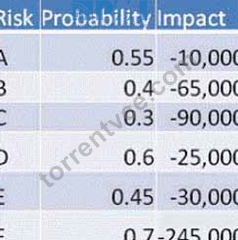
If Risk D happens in this project, how much will be left in the contingency reserve?
- A. $440,000
- B. $243,500
- C. $233,500
- D. $258,500
Answer: C
NEW QUESTION # 70
Rex is the project manager of the BDF Project. This project will last for two years and has a budget of
$2,345,000. Management has instructed Rex that the project must not go over budget as funds are very tight in the organization. During the project planning Rex and the project team discover a positive risk event to save
$75,000. Rex wants to make certain that this risk event happens so which risk response method is most appropriate?
- A. Share
- B. Mitigation
- C. Exploit
- D. Enhance
Answer: C
Explanation:
Explanation
NEW QUESTION # 71
Mary is a project manager in her organization. On her current project she is working with her project team and other key stakeholders to identify the risks within the project. She is currently aiming to create a comprehensive list of project risks so she is using a facilitator to help generate ideas about project risks.
What risk identification method is Mary likely using?
- A. Checklist analysis
- B. Expert judgment
- C. Delphi Techniques
- D. Brainstorming
Answer: D
NEW QUESTION # 72
You are the project manager of your organization. Your organization will receive a bonus if the project finishes by December 20. Management has communicated this bonus to you and your project team and has asked you to evaluate the project to see if it is possible to realize the reward. The bonus offered to your organization is $750,000. You have examined the project and believe that you can crash the project for an additional $275,000 and reach the December 20 date. Management is thrilled with your assessment and they approve the crash fee. What risk response is this?
- A. Crashing can be a type of the enhancing risk response.
- B. Crashing can be considered transference because of the $275,000 is actually paid from the bonus, which is paid by the project customer.
- C. Crashing can be a type of the exploit risk response.
- D. Crashing is the addition of labor, not a risk response.
Answer: A
NEW QUESTION # 73
You are working with your project stakeholders to identify risks within the JKP Project. You want to use an approach to engage the stakeholders to increase the breadth of the identified risks by including internally generated risk. Which risk identification approach is most suited for this goal?
- A. SWOT analysis
- B. Assumptions analysis
- C. Delphi Technique
- D. Brainstorming
Answer: A
NEW QUESTION # 74
Holly is the project manager of the GHH Project. During risk identification and the subsequent risk analysis process she has identified a risk with a high probability and high impact for her project. She and the stakeholder agree that the project management plan should be changed to eliminate the risk threat entirely.
What risk response has Holly used in this instance?
- A. This is the risk mitigation response.
- B. This is a scope change and not a risk response.
- C. This is the transference risk response.
- D. This is the avoidance risk response.
Answer: D
NEW QUESTION # 75
A project manager has been assigned to a project that is just starting. The organization has a very low risk appetite towards this project due to constraints on budget and schedule. The project stakeholders are very engaged on the project and want to ensure that there is clear visibility on the project risks and progress.
How should the project manager handle stakeholder expectations?
- A. Add buffers to the schedule to accommodate risk.
- B. Discuss the risk response strategies with the stakeholders.
- C. Ensure the risk register includes all identified risks.
- D. Develop a communication plan to share updates on risks.
Answer: D
Explanation:
Explanation
The project manager should develop a communication plan to share updates on risks (D) to handle stakeholder expectations, especially since the organization has a low risk appetite and stakeholders are very engaged. This approach ensures that stakeholders are regularly informed about the project's risks and progress, addressing their concerns and expectations. This is supported by the PMI's PMBOK Guide, Sixth Edition.
NEW QUESTION # 76
The project manager needs to create a risk management plan for a high risk project, but the company's senior management does not see value in spending time documenting major risks instead of leading the project.
What is the most appropriate action for the project manager to take first?
- A. Develop a risk management plan and present it to the sponsor.
- B. Document all identified risks.
- C. Develop a risk register and present it to the senior management
- D. Hire a risk consultant to identity the major risks.
Answer: A
NEW QUESTION # 77
When does the Identify Risks process take place in a project?
- A. At the Initiating stage.
- B. Throughout the project life-cycle.
- C. At the Executing stage.
- D. At the Planning stage.
Answer: B
NEW QUESTION # 78
You and your project team have identified the project risks and now are analyzing the probability and impact of the risks. What type of analysis of the risks provides a quick and high-level review of each identified risk event?
- A. A risk probability-impact matrix
- B. Quantitative risk analysis
- C. Qualitative risk analysis
- D. Seven risk responses
Answer: C
NEW QUESTION # 79
......
The Project Management Institute (PMI) is a globally recognized organization that offers various certifications to professionals in the project management domain. One of the most sought-after certifications from PMI is the PMI-RMP (PMI Risk Management Professional) certification. PMI Risk Management Professional certification is specifically designed for professionals who want to specialize in risk management practices and techniques.
Exam Engine for PMI-RMP Exam Free Demo & 365 Day Updates: https://actual4test.torrentvce.com/PMI-RMP-valid-vce-collection.html