

[May 31, 2026] Valid Security-Operations-Engineer Test Answers & Security-Operations-Engineer Exam PDF
Valid Google Cloud Certified Security-Operations-Engineer Dumps Ensure Your Passing
Google Security-Operations-Engineer Exam Syllabus Topics:
| Topic | Details |
|---|---|
| Topic 1 |
|
| Topic 2 |
|
| Topic 3 |
|
NEW QUESTION # 51
Your company uses Security Command Center (SCC) and Google Security Operations (SecOps). Last week, an attacker attempted to establish persistence by generating a key for an unused service account. You need to confirm that you are receiving alerts when keys are created for unused service accounts and that newly created keys are automatically deleted. You want to minimize the amount of manual effort required. What should you do?
- A. Configure a Cloud Logging sink to write logs to a Pub/Sub topic that filters for the methodName:
"google.iam.admin.v1.CreateServiceAccountKey" field. Create a Cloud Run function that subscribes to the Pub/Sub topic and deletes the service account key. - B. Use the Initial Access: Dormant Service Account Key Created finding from SCC, and ingest this finding into Google SecOps. Create a custom action in Google SecOps SOAR that is triggered on this finding. Use the built-in IDE to build code to delete the service account key.
- C. Use the Initial Access: Dormant Service Account Key Created finding from SCC, and write this finding to a Pub/Sub topic. Create a Cloud Run function that subscribes to the Pub/Sub topic and deletes the service account key.
- D. Generate a YARA-L rule in Google SecOps that detects when a service account key is created.
Using the built-in IDE, create a custom action in Google SecOps SOAR that deletes the service account key.
Answer: B
Explanation:
The most efficient solution is to use the built-in SCC detection "Initial Access: Dormant Service Account Key Created", ingest the finding into Google SecOps, and automate the response with a custom SOAR action that deletes the key. This leverages existing SCC findings for accurate detection, integrates directly with Google SecOps for centralized alerting, and minimizes manual effort by automating remediation.
NEW QUESTION # 52
You are responsible for identifying suspicious activity and security events at your organization.
You have been asked to search in Google Security Operations (SecOps) for network traffic associated with an active HTTP backdoor that runs on TCP port 5555. You want to use the most effective approach to identify traffic originating from the server that is running the backdoor. What should you do?
- A. Detect on events where network.ip_protocol is TCP.
- B. Detect on events where principal.port is 5555.
- C. Detect on events where target.port is 5555.
- D. Detect on events where network.ApplicationProtocol is HTTP.
Answer: B
Explanation:
The backdoor is running on TCP port 5555 on the server, meaning the server is the source of the traffic. In Google Security Operations (SecOps), the field principal.port represents the source port of the traffic, while target.port represents the destination. Since you want to identify traffic originating from the compromised server, filtering on principal.port = 5555 is the most effective approach.
NEW QUESTION # 53
Your Google Security Operations (SecOps) case queue contains a case with IP address entities. You need to determine whether the entities are internal or external assets and ensure that internal IP address entities are marked accordingly upon ingestion into Google SecOps SOAR. What should you do?
- A. Configure a feed to ingest enrichment data about the networks, and include these fields into your detection outcome.
- B. Indicate your organization's known internal CIDR ranges in the Environment Networks list in the settings.
- C. Modify the connector logic to perform a secondary lookup against your CMDB and flag incoming entities as internal or external.
- D. Create a custom action to ping the IP address entity from your Remote Agent. If successful, the custom action designates the IP address entity as internal.
Answer: B
Explanation:
Comprehensive and Detailed Explanation
The correct solution is Option C. Google SecOps SOAR includes a specific, built-in feature to address this exact requirement. The SOAR platform needs to be context-aware to differentiate between internal and external IPs for accurate analysis, prioritization, and playbook execution.
This is achieved by configuring the Environment Networks list within the SOAR settings. Here, an administrator defines all of the organization's internal CIDR ranges (e.g., 10.0.0.0/8, 192.168.0.0/16,
172.16.0.0/12, etc.).
When an alert is ingested from the SIEM (Chronicle) or any other source, the SOAR platform parses its entities. During this ingestion and enrichment process, it automatically cross-references every IP address entity against the configured "Environment Networks" list. If an IP address falls within any of the defined internal CIDR blocks, it is automatically flagged as "Internal." This classification is then visible to analysts in the case and can be used by playbooks to make logical decisions (e.g., initiate an endpoint scan for an internal IP vs. block an external IP at the firewall).
* Option A is incorrect because it describes enriching data in the SIEM, not the SOAR ingestion process.
* Option B is incorrect because it requires custom connector modification, which is a high-effort solution, whereas a standard, out-of-the-box setting (Option C) already exists.
* Option D is incorrect because it describes a post-ingestion playbook action, not a flag set upon ingestion
. It's also an unreliable method, as internal assets may not respond to ping due to host firewalls.
Exact Extract from Google Security Operations Documents:
Environment Networks: Google SecOps SOAR provides a configuration setting to define the organization's internal IP address space. This setting, typically found under Organization Settings > Environment Networks within the SOAR platform, allows administrators to list all internal CIDR ranges.
When alerts are ingested into SOAR, the platform automatically enriches entities. During this process, any IP address entity is checked against this defined list. If the IP address falls within one of the specified CIDR blocks, it is automatically marked with an Internal flag. This contextual awareness is critical for analysts to triage cases and for playbooks to execute the correct logic (e.g., different actions for an internal vs. external IP).
References:
Google Cloud Documentation: Google Security Operations > Documentation > SOAR > SOAR Administration > Organization Settings
NEW QUESTION # 54
Your organization has recently onboarded to Google Cloud with Security Command Center Enterprise (SCCE) and is now integrating it with your organization's SOC. You want to automate the response process within SCCE and integrate with the existing SOC ticketing system. You want to use the most efficient solution. How should you implement this functionality?
- A. Disable the generic posture finding playbook in Google Security Operations (SecOps) SOAR and enable the playbook for the ticketing system. Add a step in your Google SecOps SOAR playbook to generate a ticket based on the event type.
- B. Evaluate each event within the SCC console. Create a ticket for each finding in the ticketing system, and include the remediation steps.
- C. Use the SCC notifications feed to send alerts to Pub/Sub. Ingest these feeds using the relevant SIEM connector.
- D. Configure the SCC notifications feed to send alerts to a Cloud Storage bucket. Create a Dataflow job to read the new files, extract the relevant information, and send the information to the SOC ticketing system.
Answer: A
Explanation:
Comprehensive and Detailed Explanation
The correct answer is Option C. The prompt asks for the most efficient and automated solution for handling SCCE findings and integrating with a ticketing system. This is the primary use case for Google Security Operations SOAR.
The native workflow is as follows:
* SCCE detects a finding.
* The finding is automatically ingested into Google SecOps SIEM, which creates an alert.
* The alert is automatically sent to SecOps SOAR, which creates a case.
* The SOAR case automatically triggers a playbook.
Option C describes this process perfectly. An administrator would disable the default playbook and enable a specific playbook that uses a pre-built integration (from the Marketplace) for the organization's ticketing system (e.g., ServiceNow, Jira). This playbook would contain an automated step to generate a ticket, thus fulfilling the requirement efficiently.
Option B is a manual process. Options A and D describe complex, custom-built data engineering pipelines, which are far less efficient than using the built-in SOAR capabilities.
Exact Extract from Google Security Operations Documents:
SOAR Playbooks and Integrations: Google SecOps SOAR is designed to automate and orchestrate responses to alerts. When an alert from a source like Security Command Center (SCC) is ingested and creates a case, it can be configured to automatically trigger a playbook.
Ticketing Integration: A common playbook use case is integration with an external ticketing system. Using a pre-built integration from the SOAR Marketplace, an administrator can add a step to the playbook (e.g., Create Ticket). This action will automatically generate a ticket in the external system and populate it with details from the alert, such as the finding, the affected resources, and the recommended remediation steps.
This provides a seamless, automated workflow from detection to ticketing.
References:
Google Cloud Documentation: Google Security Operations > Documentation > SOAR > Use cases > Case Management Google Cloud Documentation: Google Security Operations > Documentation > SOAR > Marketplace integrations
NEW QUESTION # 55
Your organization has recently acquired Company A, which has its own SOC and security tooling.
You have already configured ingestion of Company A's security telemetry and migrated their detection rules to Google Security Operations (SecOps). You now need to enable Company A's analysts to work their cases in Google SecOps. You need to ensure that Company A's analysts:
- do not have access to any case data originating from outside of Company A.
- are able to re-purpose playbooks previously developed by your organization's employees.
You need to minimize effort to implement your solution. What is the first step you should take?
- A. Provision a new service account for Company A.
- B. Create a Google SecOps SOAR environment for Company A.
- C. Acquire a second Google SecOps SOAR tenant for Company A.
- D. Define a new SOC role for Company A.
Answer: D
Explanation:
The correct first step is to define a new SOC role for Company A within Google SecOps. By assigning appropriate role-based access controls, you can ensure Company A's analysts only see case data originating from their own telemetry, while still being able to reuse existing playbooks from your organization. This approach minimizes effort compared to acquiring or creating new environments or tenants.
NEW QUESTION # 56
Your company recently adopted Security Command Center (SCC) but is not using Google Security Operations (SecOps). Your organization has thousands of active projects. You need to detect anomalous behavior in your Google Cloud environment by windowing and aggregating data over a given time period, based on specific log events or advanced calculations. You also need to provide an interface for analysts to triage the alerts. How should you build this capability?
- A. Sink the logs to BigQuery, and configure Cloud Run functions to execute a periodic job and generate normalized alerts in a Pub/Sub topic for findings. Use log-based metrics to generate event-driven alerts and send these alerts to the Pub/Sub topic. Write the alerts as findings using the SCC API.
- B. Use log-based metrics to generate event-driven alerts for the detection scenarios. Configure a Cloud Monitoring alert policy to send email alerts to your security operations team.
- C. Send the logs to Cloud SQL, and run a scheduled query against these events using a Cloud Run scheduled job. Configure an aggregated log filter to stream event-driven logs to a Pub/Sub topic.
Configure a trigger to send an email alert when new events are sent to this feed. - D. Create a series of aggregated log sinks for each required finding, and send the normalized findings as JSON files to Cloud Storage. Use the write event to generate an alert.
Answer: A
Explanation:
The correct approach is to sink logs to BigQuery, where you can perform windowing and advanced aggregations over time. Then, use Cloud Run functions to periodically query BigQuery and generate normalized alerts published to a Pub/Sub topic. From there, alerts can be written back into SCC as findings via the SCC API, giving analysts a central interface for triage. This architecture supports large-scale environments, advanced calculations, and efficient integration with SCC.
NEW QUESTION # 57
Your organization recently acquired a Google Security Operations (SecOps) Enterprise Plus license. Your organization is already ingesting Cloud Audit Logs, firewall logs, proxy logs and endpoint logs, but there are no threat intelligence feeds being ingested into your Google SecOps environment. You need to design and deploy a solution that alerts your team quickly if an IOC of an active breach is observed in your environment. What should you do?
- A. Enable and configure alerting for relevant curated detection rule sets.
- B. Write, enable, and configure alerting on a custom single-event rule.
- C. Write, enable, and configure alerting on a custom multi-event rule.
- D. Create and schedule a dashboard to send periodic summaries of the active breach IOCs and their associated events.
Answer: A
Explanation:
The fastest and most effective way to alert on IOCs in Google SecOps is to enable and configure curated detection rule sets. These curated rules are maintained by Google and automatically updated with the latest threat intelligence, ensuring that if an IOC from an active breach is observed in your ingested logs, your team will receive alerts without the need to manually create or maintain custom rules.
NEW QUESTION # 58
You are threat hunting for an advanced threat group known for targeted, novel attacks by deploying campaign-specific infrastructure. You want to develop detections based on the threat group's behaviors so you can effectively detect whether the threat group has attacked your organization. What should you do?
- A. Find intelligence reports in Google Threat Intelligence that relate to the threat actor, identify their behavior in previous campaigns, and use the past behavior to design detections in Google Security Operations (SecOps).
- B. Search for the threat actor in Google Threat Intelligence, export the IOCs associated with the threat actor into a Google Security Operations (SecOps) list, and develop detections that reference this list.
- C. Identify exposed technologies and products used by your organization, and develop detections to search for signs of exploitation.
- D. Search for the threat actor in Google Threat Intelligence, review the threat actor's tactics, techniques, and procedures (TTPs), and design detections based on the TTPs in Google Security Operations (SecOps).
Answer: D
Explanation:
The most effective approach is to search for the threat actor in Google Threat Intelligence, review their tactics, techniques, and procedures (TTPs), and design detections based on those TTPs in Google SecOps. Since advanced groups often use novel, campaign-specific infrastructure, IOC- based detection is insufficient. TTP-based detection captures the underlying attacker behaviors, increasing resilience against evolving tactics.
NEW QUESTION # 59
You are using Google Security Operations (SecOps) to hunt for signs of lateral movement through Remote Desktop Protocol (RDP) in your organization. You suspect that a compromised account was used to access multiple internal systems within a short time window. You want to construct a UDM-based search to identify this activity. How should you build this query? (Choose two.)
- A. Filter for RDP connections with non-standard ports.
- B. Filter for events using protocol-level attributes that indicate RDP connections.
- C. Use a saved search to identify all events with the LATERAL_MOVEMENT tag over the past 30 days.
- D. Group events by user identity and time to identify repeated access patterns.
- E. Correlate events based on the asset role or classification such as database or user workstation.
Answer: B,D
Explanation:
Filtering for events using protocol-level attributes that indicate RDP connections ensures that the search specifically targets RDP sessions.
Grouping events by user identity and time allows you to identify repeated access patterns, which is a strong indicator of lateral movement when a single account accesses multiple systems in a short timeframe.
NEW QUESTION # 60
You are a platform engineer at an organization that is migrating from a third-party SIEM product to Google Security Operations (SecOps). You previously manually exported context data from Active Directory (AD) and imported the data into your previous SIEM as a watchlist when there were changes in AD's user/asset context data. You want to improve this process using Google SecOps. What should you do?
- A. Create a reference list that contains the AD context data. Use the reference list in your YARA-L rule to find user/asset information for each security event.
- B. Configure a Google SecOps SOAR integration for AD to enrich user/asset information in your security alerts.
- C. Create a data table that contains AD context data. Use the data table in your YARA-L rule to find user/asset data that can be correlated within each security event.
- D. Ingest AD organizational context data as user/asset context to enrich user/asset information in your security events.
Answer: D
Explanation:
The best approach is to ingest AD organizational context data directly into Google SecOps as user/asset context. This ensures that AD user and asset information is automatically enriched in security events without manual exports or watchlists. It improves correlation, investigation efficiency, and automation compared to maintaining separate reference lists or data tables.
NEW QUESTION # 61
Your organization has recently onboarded to Google Cloud with Security Command Center Enterprise (SCCE) and is now integrating it with your organization's SOC. You want to automate the response process and integrate with the existing SOW ticketing system. How should you implement this functionality?
- A. Configure the SCC notifications feed to use Pub/Sub for alerts. Create a Cloud Run function to trigger when an event arrives in the topic and generate a ticket by calling the API endpoint in the SOC ticketing system.
- B. Evaluate each event within the SCC console. Create a ticket for each finding in the ticketing system, and include the remediation steps.
- C. Use the SCC notifications feed to send alerts to Pub/Sub. Ingest these feeds using the relevant SIEM connector.
- D. Disable the generic posture finding playbook in Google Security Operations (SecOps) SOAR and enable the playbook for the ticketing system. Add a step in your Google SecOps SOAR playbook to generate a ticket based on the event type.
Answer: A
Explanation:
The correct solution is to configure the SCC notifications feed to Pub/Sub and then use a Cloud Run function triggered by new events in the topic to call the SOC ticketing system's API. This automates ticket creation for findings, integrates seamlessly with the existing SOC process, and minimizes manual intervention while ensuring timely response.
NEW QUESTION # 62
You are a security engineer at a managed security service provider (MSSP) that is onboarding to Google Security Operations (SecOps). You need to ensure that cases for each customer are logically separated. How should you configure this logical separation?
- A. In Google SecOps SOAR settings, create a permissions group for each customer.
- B. In Google SecOps Playbooks, create a playbook for each customer.
- C. In Google SecOps SOAR settings, create a new environment for each customer.
- D. In Google SecOps SOAR settings, create a role for each customer.
Answer: C
Explanation:
Comprehensive and Detailed 150 to 250 words of Explanation From Exact Extract Google Security Operations Engineer documents:
The correct mechanism for achieving logical data segregation for different customers in a Google Security Operations (SecOps) SOAR multi-tenant environment is by using Environments. The documentation explicitly states that "you can define different environments and environment groups to create logical data segregation." This separation applies to most platform modules, including cases, playbooks, and dashboards.
This feature is specifically designed for this use case: "This process is useful for businesses and Managed Security Service Providers (MSSPs) who need to segment their operations and networks. Each environment...
can represent a separate customer." When an analyst is associated with a specific environment, they can only see the cases and data relevant to that customer, ensuring strict logical separation.
While permission groups (Option C) and roles (Option A) are used to control what a user can do within the platform (e.g., view cases, edit playbooks), they do not provide the primary data segregation. Environments are the top-level containers that separate one customer's data and cases from another's. Playbooks (Option B) are automation workflows and are not a mechanism for logical separation.
(Reference: Google Cloud documentation, "Control access to the platform using SOAR permissions"; " Support multiple instances [SOAR]")
NEW QUESTION # 63
You are implementing Google Security Operations (SecOps) for your organization. Your organization has their own threat intelligence feed that has been ingested to Google SecOps by using a native integration with a Malware Information Sharing Platform (MISP). You are working on the following detection rule to leverage the command and control (C2) indicators that were ingested into the entity graph.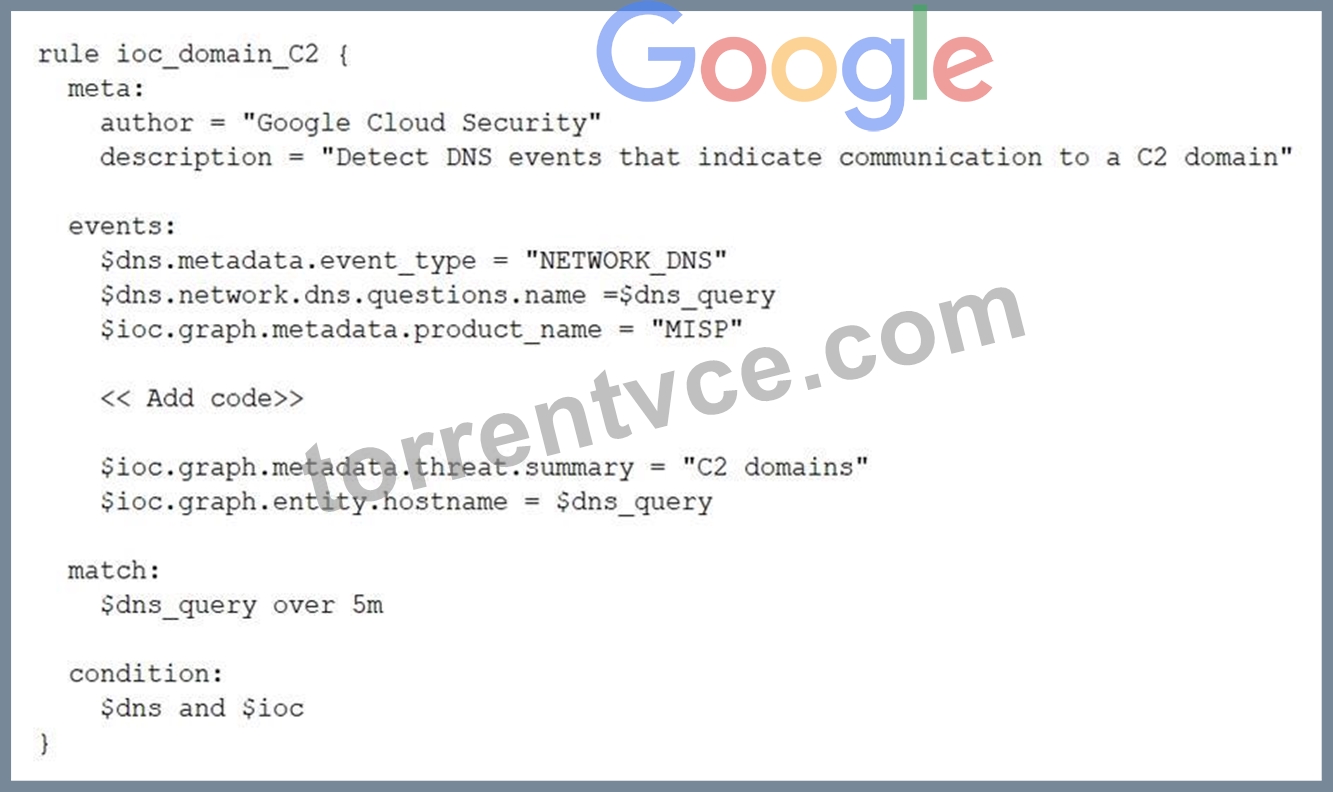
What code should you add in the detection rule to filter for the domain IOCs?
- A. $ioc.graph.metadata.entity_type = "DOMAIN_NAME"
$ioc.graph.metadata.source_type = "ENTITY_CONTEXT" - B. $ioc.graph.metadata.entity_type = "DOMAIN_NAME"
$ioc.graph.metadata.source_type = "DERIVED_CONTEXT" - C. $ioc.graph.metadata.entity_type = "DOMAIN_NAME"
$ioc.graph.metadata.source_type = "SOURCE_TYPE_UNSPECIFIED" - D. $ioc.graph.metadata.entity_type = "DOMAIN_NAME"
$ioc.graph.metadata.source_type = "GLOBAL_CONTEXT"
Answer: A
Explanation:
This code ensures your rule matches IOCs classified as domain names and sourced directly as entity context from MISP, allowing precise correlation between DNS queries and known C2 domains.
NEW QUESTION # 64
You received an alert from Container Threat Detection that an added binary has been executed in a business critical workload. You need to investigate and respond to this incident. What should you do?
Choose 2 answers
- A. Notify the workload owner. Follow the response playbook. and ask the threat hunting team to identify the root cause of the incident.
- B. Silence the alert in the Security Command Center (SCC) console, as the alert is a low severity finding.
- C. Review the finding, investigate the pod and related resources, and research the related attack and response methods.
- D. Review the finding, quarantine the cluster containing the running pod. and delete the running pod to prevent further compromise.
- E. Keep the cluster and pod running, and investigate the behavior to determine whether the activity is malicious.
Answer: A,C
Explanation:
Comprehensive and Detailed Explanation
The correct actions are C and D, as they represent the standard, parallel process for incident response:
technical investigation and procedural/communicative response.
* Technical Investigation (Option D): The immediate priority is to understand the alert. An analyst must review the Container Threat Detection finding in Security Command Center (SCC) to understand what was detected. This is followed by investigating the affected pod, its container, the node it's running on, and any associated service accounts to determine the initial blast radius and gather forensic data. Researching the binary and related TTPs (Tactics, Techniques, and Procedures) helps contextualize the attack.
* Procedural Response (Option C): Concurrently, the organizational response plan must be activated.
This involves notifying the business-critical workload owner (stakeholder communication), initiating the formal, documented incident response playbook, and escalating to specialized teams, like threat hunting, for deeper root cause analysis that goes beyond the initial triage.
Option A is incorrect because deleting the pod immediately is a premature remediation step that destroys critical forensic evidence. Option B is incorrect because "keeping the cluster and pod running" without any containment is reckless and could allow an attacker to pivot. Option E is incorrect because an unauthorized binary execution in a critical workload is a high-severity event, not a low-severity finding to be silenced.
Exact Extract from Google Security Operations Documents:
Responding to Container Threat Detection findings: When a Container Threat Detection finding is generated, it indicates a potential security issue that requires investigation. The first step is to review the finding details in Security Command Center (SCC) to understand the nature of the threat, such as K8S_BINARY_EXECUTED.
The recommended workflow involves:
* Investigate: Examine the affected Kubernetes resources, such as the Pod, Container, and Node. Use tools like kubectl to inspect the pod configuration, running processes, and network connections.
Research the associated attack and response methods to understand the threat actor's TTPs.
* Respond: Follow the organization's incident response playbook. This includes notifying the workload owner and relevant stakeholders. Contain the threat by isolating the pod or node, but avoid deleting resources immediately to preserve evidence for forensic analysis.
* Escalate: For complex incidents, engage the threat hunting or forensics team to conduct a thorough investigation, identify the root cause, and determine the full scope of the compromise.
References:
Google Cloud Documentation: Security Command Center > Documentation > Manage findings > Responding to Container Threat Detection findings Google Cloud Documentation: Google Security Operations > Documentation > Incident Response > Incident Response Playbooks
NEW QUESTION # 65
A Google Security Operations (SecOps) detection rule is generating frequent false positive alerts.
The rule was designed to detect suspicious Cloud Storage enumeration by triggering an alert whenever the storage.objects.list API operation is called using the api.operation UDM field.
However, a legitimate backup automation tool that uses the same API, causing the rule to fire unnecessarily. You need to reduce these false positives from this trusted backup tool while still detecting potentially malicious usage. How should you modify the rule to improve its accuracy?
- A. Adjust the rule severity to LOWto deprioritize alerts from automation tools.
- B. Convert the rule into a multi-event rule that looks for repeated API calls across multiple buckets.
- C. Replace api.operation with api.service_name = "storage.googleapis.com" to narrow the detection scope.
- D. Add principal.user.email != "[email protected]" to the rule condition to exclude the automation account.
Answer: D
Explanation:
The most accurate way to reduce false positives is to exclude the known trusted backup automation account by adding a condition such as principal.user.email != "backup- [email protected]". This keeps the rule active for all other accounts, ensuring you still detect suspicious or malicious Cloud Storage enumeration while preventing unnecessary alerts from legitimate automation.
NEW QUESTION # 66
You are investigating whether an advanced persistent threat (APT) actor has operated in your organization's environment undetected. You have received threat intelligence that includes:
- A SHA256 hash for a malicious DLL
- A known command and control (C2) domain
- A behavior pattern where rundll32.exe spawns powershell.exe with obfuscated arguments Your Google Security Operations (SecOps) instance includes logs from EDR, DNS, and Windows Sysmon. However, you have recently discovered that process hashes are not reliably captured across all endpoints due to an inconsistent Sysmon configuration. You need to use Google SecOps to develop a detection mechanism that identifies the associated activities. What should you do?
- A. Use Google SecOps search to identify recent uses of rundll32.exe, and tag affected assets for watchlisting.
- B. Build a reference list that contains the hash and domain, and link the list to a high-frequency rule for near real-time alerting.
- C. Write a multi-event YARA-L detection rule that correlates the process relationship and hash, and run a retrohunt based on this rule.
- D. Create a single-event YARA-L detection rule based on the file hash, and run the rule against historical and incoming telemetry to detect the DLL execution.
Answer: C
Explanation:
Since process hashes are not consistently available across all endpoints, relying solely on the DLL hash would miss activity. The best solution is to write a multi-event YARA-L detection rule that correlates the process relationship (rundll32.exe spawning powershell.exe with obfuscated arguments) together with the C2 domain and hash when available, and run a retrohunt. This approach detects both behavior-based and IOC-based indicators, ensuring coverage even when hashes are missing.
NEW QUESTION # 67
You are configuring a new integration in Google Security Operations (SecOps) to perform enrichment actions in playbooks. This enrichment technology is located in a private data center that does not allow inbound network connections. You need to connect your Google SecOps instance to the integration. What should you do?
- A. Create a remote agent in the private data center. Configure an instance of the integration to run on a remote agent in Google SecOps.
- B. Create a forwarder in the private data center. Configure an instance of the integration to run on the forwarder.
- C. Create a network route in Google Cloud to the private data center.
- D. Query the enrichment source in the private data center and upload the results to the case wall in Google SecOps.
Answer: A
Explanation:
The correct approach is to create a remote agent in the private data center and configure the integration to run on that agent. Remote agents can initiate outbound connections to Google SecOps, enabling playbook enrichment without requiring inbound network access, which adheres to the private data center's network restrictions.
NEW QUESTION # 68
Your company recently started pulling JSON logs from a third-party system into Google Security Operations (SecOps). You noticed that some fields are missing, and you want to parse them into UDM fields as quickly as possible. What should you do?
- A. Configure auto extraction to add the additional fields.
- B. Create parser extensions using the no-code approach.
- C. Submit a parser improvement request to Cloud Customer Care.
- D. Create parser extensions using the code snippet approach.
Answer: B
Explanation:
The fastest way to handle missing fields in JSON logs is to create parser extensions using the no- code approach in Google SecOps. This allows you to quickly map additional fields into UDM without writing code or waiting on support requests, ensuring rapid parsing and normalization of the third-party logs.
NEW QUESTION # 69
You have been tasked with developing a new response process in a playbook to contain an endpoint. The new process should take the following actions:
- Send an email to users who do not have a Google Security Operations (SecOps) account to request approval for endpoint containment
- Automatically continue executing its logic after the user responds
You plan to implement this process in the playbook by using the Gmail integration. You want to minimize the amount of effort required by the SOC analyst. What should you do?
- A. Use the 'Send Email' action to send an email requesting approval to contain the endpoint, and use the 'Wait For Thread Reply' action to receive the result. The analyst manually contains the endpoint.
- B. Set the containment action to 'Manual' and assign the action to the appropriate tier. Contact the user by email to request approval. The analyst chooses to execute or skip the containment action.
- C. Set the containment action to 'Manual' and assign the action to the user to execute or skip the containment action.
- D. Generate an approval link for the containment action and include the placeholder in the body of the 'Send Email' action. Configure additional playbook logic to manage approved or denied containment actions.
Answer: D
Explanation:
The correct approach is to generate an approval link for the containment action and embed it in the email sent via the Gmail integration. When the user clicks the link (approve/deny), the playbook automatically resumes execution and follows the logic for approved or denied outcomes. This ensures:
- The process is automated and requires minimal SOC analyst effort.
- Users without SecOps accounts can still approve actions securely through email.
- The playbook continues automatically based on the response, instead of waiting for a manual analyst decision.
NEW QUESTION # 70
You have identified and isolated a new malware sample installed by an advanced threat group that you believe was developed specifically for an attack against your organization. You want to quickly and efficiently analyze this malware to get IOCs without alerting the threat group. What should you do?
- A. Calculate the file checksum for the malware, and search for the checksum in GoogleThreat Intelligence by using VirusTotal.
- B. Upload the malware to Google Threat Intelligence by using VirusTotal.
- C. Upload the malware to Google Threat Intelligence by using Private Scanning.
- D. Search for the threat group in Google Threat Intelligence.
Answer: C
Explanation:
The correct action is to upload the malware to Google Threat Intelligence using Private Scanning.
Private Scanning allows you to analyze malware safely and extract IOCs without sharing the sample publicly. This prevents alerting the threat group while still enabling rapid and detailed intelligence gathering.
NEW QUESTION # 71
Which Google Cloud security feature MOST helps enforce the principle of least privilege at scale?
- A. IAM predefined roles and conditional IAM policies
- B. Cloud NAT
- C. VPC Firewall Rules
- D. Binary Authorization
Answer: A
Explanation:
IAM predefined roles and conditions minimize excessive permissions and limit blast radius.
NEW QUESTION # 72
......
Security-Operations-Engineer Dumps Real Exam Questions Test Engine Dumps Training: https://actual4test.torrentvce.com/Security-Operations-Engineer-valid-vce-collection.html