

[Aug-2026] Download Real PMI CAPM Exam Dumps Test Engine Exam Questions
New CAPM exam dumps Use Updated PMI Exam
The Certified Associate in Project Management (CAPM) certification exam is a globally recognized certification offered by the Project Management Institute (PMI). The CAPM certification is designed for individuals who are new to the project management field or are looking to gain a deeper understanding of project management principles and techniques.
What is the duration of CAPM Exam
The duration of this exam is 3 hours.
NEW QUESTION # 667
What tools or techniques are necessary to create the project management plan?
- A. Expert judgment and data gathering
- B. Meetings and data analysis
- C. Data analysis and expert judgment
- D. Interpersonal skills and change control
Answer: A
Explanation:
According to the PMBOKGuide, the Develop Project Management Plan process utilizes a specific set of Tools and Techniques to integrate all subsidiary plans and baselines into a comprehensive document.
* Expert Judgment: This is the most critical tool for this process. It involves consulting with individuals or groups with specialized knowledge or training in project strategy, tailoring the project management process to meet the project needs, and determining the technical and management details to be included in the plan.
* Data Gathering: This involves techniques such as brainstorming, checklists, focus groups, and interviews. These tools are used to collect information from stakeholders and team members regarding how the project should be managed, executed, and controlled.
* Integrated Approach: While meetings and interpersonal skills (like facilitation) are also used in this process, the standard PMI documentation emphasizes Expert Judgment and Data Gathering as the foundational methodologies for synthesizing diverse requirements into a single, cohesive management plan.
Why other options are incorrect:
* Option A: Meetings and data analysis: While meetings are used, " data analysis " is more commonly associated with the Monitor and Control processes (like analyzing performance data) rather than the initial creation of the management plan itself.
* Option C: Interpersonal skills and change control: Interpersonal and team skills (facilitation, conflict management) are indeed used, but Change Control is a separate process (Perform Integrated Change Control) that occurs after the project management plan has been baselined.
* Option D: Data analysis and expert judgment: Again, " data analysis " (such as alternatives analysis) can be used, but per the official PMI process mapping for Develop Project Management Plan, Data Gathering is a more primary and frequently cited tool for this specific stage than data analysis.
NEW QUESTION # 668
What is the minimum a project schedule must include?
- A. A critical path diagram
- B. Variance analysis
- C. A planned start date and a planned finish date for each schedule activity
- D. Critical chain analysis
Answer: C
Explanation:
Section: Volume E
NEW QUESTION # 669
An adaptive project manager is migrating the company's new website. The project manager must work with the team to invest full capacity on this project because it is the company's top-ranked project in the portfolio. In order to increase throughput and provide consistent delivery, the project manager needs to assign members who are currently involved with other projects.
How should the project manager assign the team members to this project?
- A. Full allocation
- B. Prediction
- C. Task switching
- D. Multitasking
Answer: A
NEW QUESTION # 670
In which Process Group are lessons learned documented?
- A. Executing
- B. Initiating
- C. Closing
- D. Planning
Answer: C
Explanation:
Section: Volume D
Explanation/Reference:
NEW QUESTION # 671
Which of the following correctly explains the term "progressive elaboration'?
- A. Project specifications becoming more explicit and detailed as the project progresses
- B. Elaborate tracking of the project specifications with a change control system
- C. Changing project specifications continuously
- D. Elaborate tracking of the project progress
Answer: A
NEW QUESTION # 672
Plan Schedule Management is a process in which Knowledge Area?
- A. Project Time Management
- B. Project Human Resource Management
- C. Project Integration Management
- D. Project Scope Management
Answer: A
Explanation:
Section: Volume A
Explanation:
Schedule -> Time Management Easy question
NEW QUESTION # 673
Ensuring that both parties meet contractual obligations and that their own legal rights are protected is a function of:
- A. Plan Procurements.
- B. Close Procurements.
- C. Conduct Procurements.
- D. Administer Procurements,
Answer: D
Explanation:
Section: Volume D
NEW QUESTION # 674
A project manager of a civil construction project is trying to understand the local laws. What example of tailoring procurement could this best be described as?
- A. Availability of contractors
- B. Physical location tailoring
- C. Compliance and governance
- D. Complexity of procurement
Answer: B
NEW QUESTION # 675
A project's business analyst has to understand the newly acquired technology and the impact it will have on the organization. Which tool should be used to understand the new technology?
- A. Responsible, accountable, consulted, informed (RACI)
- B. Must have, should have, could have, won't have (MoSCoW)
- C. Strengths, weaknesses, opportunities, threats (SWOT)
- D. Work breakdown structure (WBS)
Answer: C
NEW QUESTION # 676
A full-time project manager with low to moderate authority and part-time administrative staff is working in an organizational structure with which type of matrix?
- A. Managed
- B. Balanced
- C. Strong
- D. Weak
Answer: B
Explanation:
Explanation/Reference:
Explanation:
Project managers have the highest level of power and authority in a projectized organization. They also have high levels of power and authority in a strong matrix; however, a matrix organization is a blend of functional and projectized organizations, and therefore, the project manager does not have quite the same level of authority as they would in a projectized organization.
NEW QUESTION # 677
Within a matrix organization, dual reporting of team members is a risk for project success. Who is responsible for managing this dual reporting relationship factor?
- A. Project management office
- B. Functional manager supported by the project manager
- C. Functional manager
- D. Project manager
Answer: D
NEW QUESTION # 678
Which standard has interrelationships to other project management disciplines such as program management and portfolio management?
- A. The Standard for Program Management
- B. Organizational Project Management Maturity Model (OPM3$)
- C. Program Management Body of Knowledge Guide
- D. Guide to the Project Management Body of Knowledge (PMBOK)
Answer: D
NEW QUESTION # 679
Directing another person to get from one point to another using a known set of expected behaviors and the ability to lead a team and inspire them to do their jobs well is related to?
- A. Leadership and management
- B. Influence and challenge
- C. Innovation and administration
- D. Engagement and guidance
Answer: A
Explanation:
According to the PMBOKGuide, there is a distinct and critical difference between Management and Leadership, though a successful project manager must balance both. The description in the question highlights the dual nature of these two roles:
* Management: This relates to directing another person to get from one point to another using a known set of expected behaviors. It focuses on systems, structures, administration, and results. Management is about doing things right, maintaining the status quo, and following the established plan (the " how " and
" when " ).
* Leadership: This relates to the ability to lead a team and inspire them to do their jobs well. It involves working with others through discussion or debate to guide them from one point to another. Leadership is about doing the right things, innovating, focusing on relationships, and inspiring trust (the " what " and " why " ).
Key Differences according to PMI: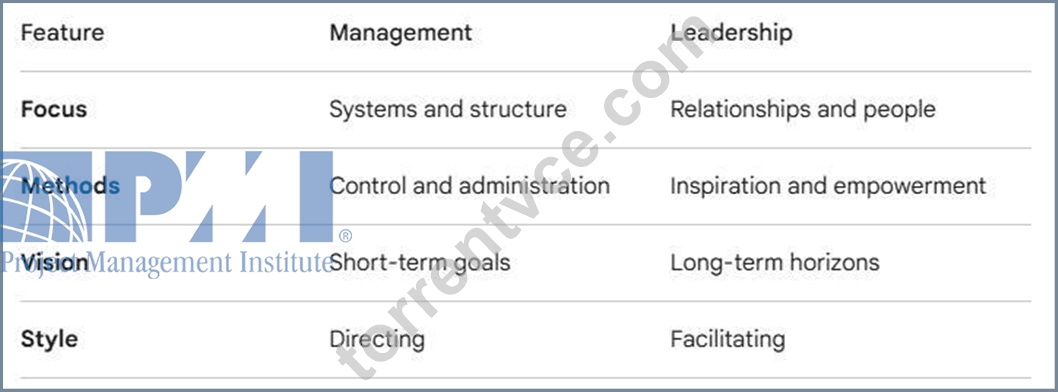
Analysis of other options:
* A. Influence and challenge: These are components or skills of leadership, but they do not capture the administrative " known set of expected behaviors " described in the first half of the question.
* B. Innovation and administration: While " Innovation " is often a trait of leadership and " Administration " a trait of management, these are individual qualities rather than the core disciplines themselves.
* D. Engagement and guidance: These are general terms used in stakeholder management and coaching, but they do not represent the formal PMI distinction between the two primary roles of a project manager.
Per PMI standards, the PMI Talent Triangle emphasizes that a project manager must be competent in technical project management (Management) while also possessing the soft skills required to guide and motivate a team (Leadership).
NEW QUESTION # 680
The milestone list is an input to which process from the Planning Process Group?
- A. Sequence Activities
- B. Define Activities
- C. Estimate Activity Durations
- D. Estimate Activity Resources
Answer: A
NEW QUESTION # 681
A project manager is managing a small project that has a time constraint. What should the project manager do to ensure the delivery is on time?
- A. Schedule the tasks in parallel.
- B. Schedule the tasks in sequence.
- C. Expand the scope of the project.
- D. Increase quality review cycles.
Answer: A
NEW QUESTION # 682
When establishing a contingency reserve, including time, money and resources, how is the risk being handled?
- A. Mitigating
- B. Accepting
- C. Transferring
- D. Avoiding
Answer: A
NEW QUESTION # 683
Which is an aspect of the requirements management plan?
- A. Impact analysis
- B. Detailed project scope statement
- C. Creation of work breakdown strucure (WBS)
- D. Duration for implementation
Answer: A
NEW QUESTION # 684
The group technique that enhances brainstorming with a voting process used to rank the most useful ideas for prioritization is called the:
- A. majority rule technique.
- B. nominal group technique.
- C. Delphi technique,
- D. idea/mind mapping technique.
Answer: B
Explanation:
Explanation/Reference:
Explanation:
5.2.2.4 Group Creativity Techniques
Several group activities can be organized to identify project and product requirements. Some of the group creativity techniques that can be used are:
Brainstorming. A technique used to generate and collect multiple ideas related to project and product
requirements. Although brainstorming by itself does not include voting or prioritization, it is often used with other group creativity techniques that do.
Nominal group technique. A technique that enhances brainstorming with a voting process used to rank
the most useful ideas for further brainstorming or for prioritization.
Idea/mind mapping. A technique in which ideas created through individual brainstorming sessions are
consolidated into a single map to reflect commonality and differences in understanding, and generate new ideas.
Affinity diagram. A technique that allows large numbers of ideas to be classifed into groups for review
and analysis.
Multicriteria decision analysis. A technique that utilizes a decision matrix to provide a systematic
analytical approach for establishing criteria, such as risk levels, uncertainty, and valuation, to evaluate and rank many ideas.
NEW QUESTION # 685
A graphic display of project team members and their reporting relationships is known as a:
- A. Project organization chart.
- B. Responsibility assignment matrix (RAM).
- C. Resource breakdown structure (RBS).
- D. Resource calendar.
Answer: A
Explanation:
Section: Volume B
Explanation:
Project organization charts. A project organization chart is a graphic display of project team members and their reporting relationships. It can be formal or informal, highly detailed or broadly framed, based on the needs of the project. For example, the project organization chart for a 3,000-person disaster response team will have greater detail than a project organization chart for an internal, twenty-person project.
NEW QUESTION # 686
Stakeholder satisfaction should be managed as a key project:
- A. Process
- B. Initiative
- C. Benefit
- D. Objective
Answer: D
Explanation:
Section: Volume A
NEW QUESTION # 687
Why is required in a project?
- A. Because a one-size-fits-all approach avoids complications and saves time.
- B. Project managers should apply every process in the PMBOK Guide to the project, so failoring is not requires.
- C. Because every project is unique and not every tool, technique, input, or output identified in the PMBOK Guide is required.
- D. Because tailoring allows us to identify the techniques, procedures, and system practices used by those in the project.
Answer: C
Explanation:
According to the PMBOKGuide, Tailoring is a necessary aspect of project management because projects are unique. Not every project will require every process, tool, technique, input, or output described in the standards.
* Uniqueness of Projects: Every project exists in a different context, with different levels of complexity, risk, size, and team experience. Therefore, the project manager and the project management team must select only those processes that are appropriate for that specific project.
* Competing Constraints: Tailoring ensures that the project manager considers the competing constraints of scope, schedule, cost, resources, quality, and risk. By choosing the right " fit, " the team avoids wasting time and resources on unnecessary documentation or bureaucratic steps that do not add value to the project ' s outcome.
* Professional Responsibility: It is the responsibility of the project manager and the project management team to determine which processes are relevant. This decision-making process is based on organizational culture, stakeholder needs, and the specific nature of the work.
Why other options are incorrect:
* Option A: A " one-size-fits-all " approach is actually what the PMBOKGuide warns against. This approach often leads to inefficiency, as small projects might be overwhelmed by heavy processes, and large projects might be under-managed.
* Option C: While tailoring involves looking at techniques and procedures, the primary reason for it is to ensure the management approach fits the unique needs of the project, not just to identify what others are doing.
* Option D: This is incorrect because applying every single process to every project (sometimes called " over-management " ) is counterproductive and inefficient. The PMBOKGuide is a framework of best practices, not a rigid set of rules that must be followed in their entirety for every project.
NEW QUESTION # 688
......
The CAPM is an associate-level certification provided by the Project Management Institute (PMI) that creates a foundation for further advancement in this sphere. The CAPM certificate corresponds to global standards of the industry giving its holder plenty of pay perks and job opportunities so by passing its related CAPM test, you will prove your knowledge of the core best practices that are vital for understanding project management principles.
Pass Your CAPM Dumps as PDF Updated on 2026 With 1328 Questions: https://actual4test.torrentvce.com/CAPM-valid-vce-collection.html